
Why Your Business Needs a Website

Eduard Albu
14 Mar 2026•13 min read
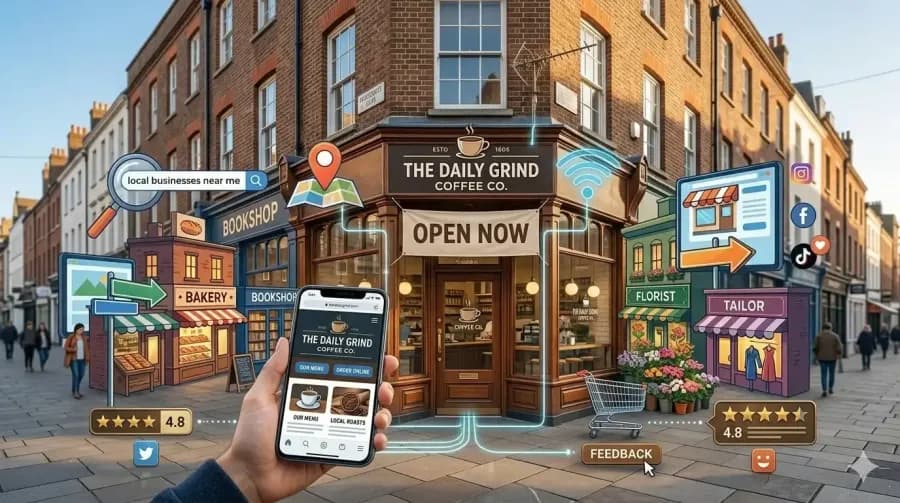
Think about the last time you searched for a restaurant, a tradesperson, or a beauty salon. Chances are you opened Google and typed a few words. If your business doesn't show up in that search, you've already lost a potential customer — without even knowing it.
This is why a website is no longer a luxury — it's a necessity. Whether you run a restaurant in Brașov, a hair salon in Cluj, or you're an electrician in Timișoara, an online presence can transform your business.
Why Customers Search Online Before They Buy
Google Is the New Word of Mouth
Referrals from friends still matter, but today people verify every recommendation online. When someone tells them "I heard about a great salon," the first thing they do is Google it to see photos, reviews, and prices.
Without a website, you don't exist for these people. Or worse — you exist as an incomplete, outdated Google listing that you have no control over.
Consider a concrete example: someone in Brașov needs an emergency plumber at 9pm. They type "emergency plumber Brașov" into Google and see the first 3-4 results. If you're not among them, that customer calls your competitor — even if you're better, cheaper, or closer. Google Maps and organic search results are the new first impression. A well-optimized Google Business Profile linked to a credible website can bring you customers who didn't even know you existed before that search.
Customers Check Your Credibility Before They Call
Think about the last significant purchase you made. Did you call the first number you found, or did you research first? Did you read reviews, look at the portfolio, check whether the company was legitimate?
Your customers do the same. A professional website signals that you're serious, that you won't disappear overnight, and that you care about the image of your business.
In practice, people check whether the site loads quickly and looks good on mobile, whether there are real photos of your work or products, whether they can find reviews or testimonials from other clients, whether the address and phone number are easy to find, and whether there's an SSL certificate — that padlock in the address bar that shows the site is secure. The absence of any of these elements can prompt a potential customer to close the tab and look elsewhere. A well-built website checks all these boxes without visitors having to hunt for them.
What a Website Does for Your Business
1. Makes You Visible When Customers Are Searching
When someone searches "hair salon Brașov" or "emergency plumber Cluj," Google displays results — and the top results capture almost all the traffic. Without an optimized website, you have no chance of appearing at the front.
A well-built website, with the right information and relevant content, puts you on the map — literally.
Local visibility means more than just appearing in Google. It means appearing when the search includes your city, your area, or a specific service you offer. Local SEO relies on three elements: a website with content relevant to your area, a complete Google Business Profile, and positive reviews from customers. Without a website, the first element is completely missing, and the other two lose much of their effectiveness. With a properly optimized site, even a small business can hold top positions in local search results for the searches that actually matter.
2. Works Around the Clock, Even While You Sleep
Your employees have working hours. You need rest. But customers look for information at any time — in the evening after work, on Sunday morning, over the weekend.
Your website is the only employee that works 24/7, without breaks, without vacations, and without a salary.
It answers customer questions, presents your services, and can even take bookings or orders — even at midnight.
Imagine you run a beauty salon and a client decides at 11pm that she wants to book a manicure for the weekend. If you have an online booking system integrated into your site, she can reserve her slot without calling you and without waiting until you open the next day. You wake up in the morning with a confirmed booking already in place. The same principle applies to a restaurant with a reservation form, a tradesperson with a quote request form, or any business offering services that can be scheduled in advance. Your website works for you while you sleep.
3. Builds Credibility and Authority
Compare two scenarios:
- Option A: You search for a car repair shop and find a Facebook page with the last post from 8 months ago.
- Option B: You find a website with a photo gallery of completed work, a full list of services, estimated pricing, and reviews from satisfied customers.
Which one do you call? The answer is obvious.
Online credibility is built through multiple elements that together form a complete picture. A professional design suggests that your business is stable and that you invest in it. A testimonials section with real client photos shows you have experience and that people are satisfied. A contact page with a physical address and phone number confirms you exist in the real world. An active SSL certificate indicates concern for security. All of these together create that first impression that makes the difference between a visitor who calls and one who closes the tab.
4. You Control the Information About Your Business
Without your own website, your information is scattered across platforms you don't control — Google Maps, Facebook, various directories. The data can be incorrect, incomplete, or outdated.
With your own website, you decide what customers see: updated hours, correct prices, newly added services, seasonal promotions.
Beyond that, external platforms have their own rules that change without asking you. Facebook's algorithm may decide tomorrow that your posts reach 2% of followers instead of 20%. A Google Maps update may display incorrect information about your opening hours. An online directory may publish false reviews that you can't effectively challenge. Your own website is the only platform you control completely — the content, the design, the message, and the customer experience. It's the foundation of your online presence, on which everything else rests, and that consistency matters enormously to customers who find you through different channels.
Real-World Examples
The Restaurant That Doubled Its Bookings
A restaurant in central Brașov was doing well on word-of-mouth referrals but had stagnated. After launching a simple website with a menu, food photos, and a reservation form, online bookings increased significantly — particularly from tourists searching for local restaurants before arriving in the city.
The Google Maps pin connected to the site immediately appeared more credible, and tourists searching "traditional Romanian restaurant Brașov" or "restaurant city center Brașov" began finding the restaurant in the first results. The online reservation form eliminated phone calls during busy service times and allowed the restaurant to automatically confirm available seats. The restaurant could also track which channels bookings came from — Google, Facebook, or direct — helping them plan for seasonal tourist peaks more predictably. An updated digital menu also reduced repetitive inquiries on Facebook. The investment paid for itself quickly through additional bookings driven entirely by online searches.
The Beauty Salon in the Neighborhood
A beauty salon owner in Florești relied exclusively on Facebook for her online presence. After building a website with a portfolio of her work and an online booking system, she attracted new clients from outside the neighborhood — people who had searched "gel nails salon Cluj" and found her in the first results.
The before-and-after photo gallery was the key element — potential clients could see the quality of the work before booking an appointment. The online booking system reduced dead time in the calendar, since clients could book directly into open slots without back-and-forth phone calls. The site also served as a portfolio for Instagram, where clients shared photos of their results and directed their followers to the site for bookings. The outcome: a full two-week waiting list within three months of launch.
The Tradesperson Who Stopped Losing Clients to Competitors
A licensed plumber in Timișoara was losing clients to larger firms simply because he didn't appear online. A simple website with a list of services, coverage area, and a prominent phone number brought him new clients in the first few months — customers who would otherwise have called the competition.
A detailed services page — with clear explanations of each job type, estimated timeframes, and indicative pricing — attracted better-informed clients who knew what to expect. A section dedicated to coverage areas, listing the neighborhoods and localities served, helped the site appear in specific local searches like "plumber Timișoara Fabric" or "certified plumber Giroc." Google reviews linked to the site confirmed credibility. The craft was the same as before, but now the right clients could find him and contact him directly through the site.
What Happens Without a Website
Customers Go to Your Competitors
When a potential customer can't find you online, it doesn't mean they give up on the service — it means they call someone else. Your competitor who has a website, a photo gallery, and reviews will win that customer.
And it's not just customers who are actively searching. There are also passive customers — those who don't have an urgent need right now, but are exploring options. They compare several providers, read reviews, and make decisions over time. Without an online presence, you're never on their shortlist. The competitor with a good site, positive reviews, and a real photo gallery will win all these customers without you ever knowing you lost them. The cumulative effect of these daily losses far exceeds the cost of a professional website. Every day without a website is a day this competition plays out to your disadvantage.
You Lose Customers Who Are New to the Area
Tourists, business travelers, or people who have recently moved to your city don't have a local network of recommendations. They rely entirely on online searches. Without a website, you're invisible to them.
Brașov attracts hundreds of thousands of tourists each year, many from across Romania and abroad. Before they arrive, most research online: where to eat, where to stay, what local services they might need. Business travelers visiting for work need fast, reliable service providers and search online hours before they arrive. A tourist searching "dentist Brașov" or "car repair Brașov" on Google before a trip will always choose the provider with a clear site and good reviews. The same applies to people who have recently moved to the city and don't yet have a local recommendation network. This is a high-potential category of customers you lose entirely without an online presence.
Your Business Image Is Controlled by Others
If you don't have your own website, the first impression of your business will be formed by a negative Google review, a poor photo on Facebook, or an incomplete listing on an online directory. You control nothing.
Research shows that 75% of users form an opinion about a business based on the look of its website in under 10 seconds. If you have no website, this 10-second judgment is made based on whatever fragments of information algorithms have gathered about you — and you have no say in it. An unprofessional photo posted by a customer on an online directory can become the first impression hundreds of potential clients form of your business. Your own website gives you back control over that first impression: you decide what people see when they search for your business and how it is presented.
The True Cost of Not Having a Website
Many business owners delay building a website because of the costs. But they rarely calculate the cost of missed opportunities.
If you lose 5 new clients per month due to a lack of online presence, and each client is worth an average of €60, that's €300 lost per month — or €3,600 per year. Against that, the cost of a professional website looks very different. A monthly subscription of 300-400 RON means roughly €720-960 per year — a fraction of the value of the clients you're losing without knowing it. What's more, a well-optimized site doesn't just bring 5 new clients per month — it can bring 10, 20, or more, depending on your field and how much online competition exists in your area. The real calculation isn't "how much does the site cost" but "how much more do I earn with a site versus without one."
What an Effective Website Must Include
Not every website delivers results. An effective website for a small business needs:
- Clear information about your services — what you do, for whom, and in what area
- Visible contact details — phone number and address easy to find
- Real photos of your work, products, or premises
- Reviews or testimonials from satisfied customers
- A clear call to action — "Call Now," "Book Online," "Request a Quote"
A simple, well-structured, and fast website will always outperform a complicated and slow one. Loading speed is critical — every additional second of waiting increases the abandonment rate by approximately 20%. A site that loads in under 2 seconds on mobile, with clear information and a visible call button, will convert visitors into customers far more effectively than a complex, animation-heavy site that loads slowly. Simple means effective. And effective means more customers for you.
Conclusion: The First Step Is What Matters
You don't need to have the perfect website from day one. You need to start. A simple, professional website launched today is infinitely more valuable than the perfect website you've been putting off for two years.
Every day without an online presence is a day when potential customers go to your competitors. Your business deserves to be found.
The first step is simpler than you think. You don't need months of planning or a large budget. You need a reliable provider who understands what matters for a small business — local visibility, fast loading, clear content, and support when a problem arises. With SiteCare, you can have a professional website delivered within 48 hours, at 300-400 RON per month, with no large upfront investment. The 15-minute conversation to find out exactly what a site for your business would involve costs nothing.
If you'd like to see what a website for your business would look like and what it would cost, get in touch for a no-obligation conversation.